Cassy Marzette woke up in the hospital and decided she was going to do a one-woman play. The play would be called “A Conversation with Ashes” and it would be based around a recurring dream where Marzette fights with herself.
“Stop. Breathe and just try. Just fuckin’ try.”
“It hurts too much to live. I’m not who you think I am. I’m not who you think I can be.”
She walks up to a mirror and witnesses her younger-self burst into flames and falls to a pile of ash.
Madison-based artist Cassy Marzette is a 28-year old visual and performance artist, writer and podcast producer. Beyond that, she is a young woman on a path to find her voice and use that voice to heal from her traumas and help others do the same.
This summer amidst the protests, she painted the sprawling yellow mural outside of Goodman’s Jewelers on State Street with a team of Black women. Atop the yellow paint are Black girls— some with smiles and others without faces. In bold blue font are words and phrases like “BRILLIANT” and “Our vision is for Black girls to be Safe! Everywhere They Are!” Yellow was chosen to represent joy and the hope they have for the future.
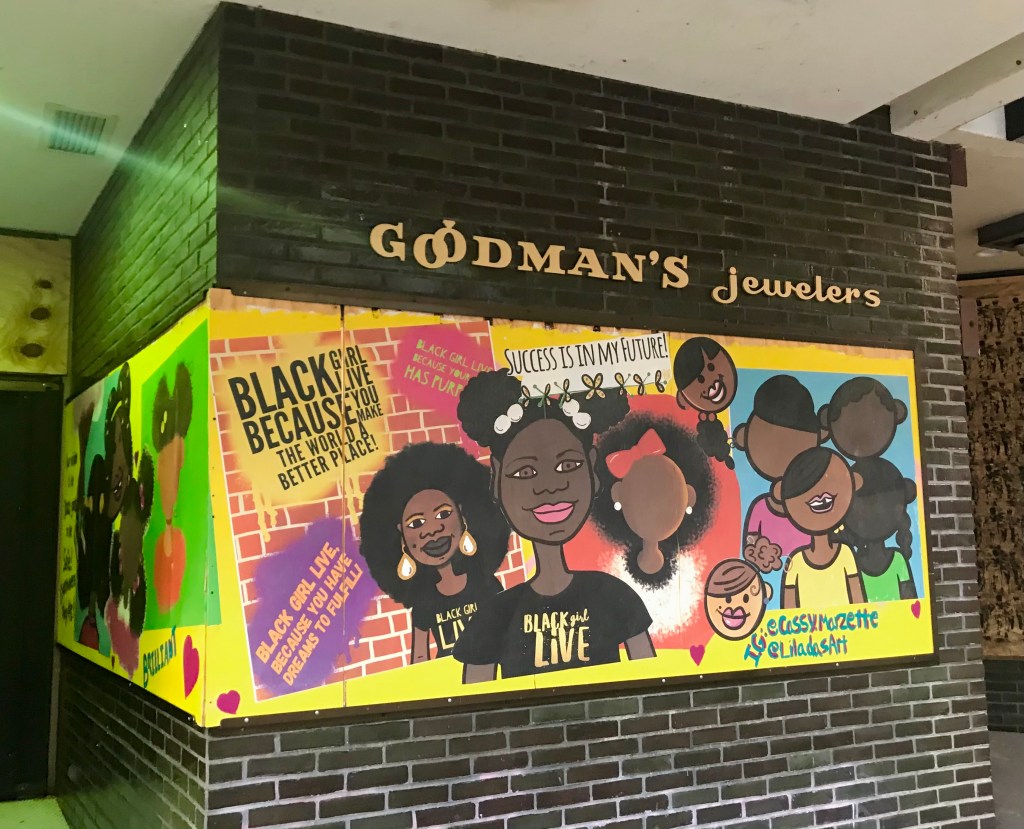
“The mural was the first time I’d really done art for myself—using my voice for something,” Marzette said.
She spent years making art of what other people wanted and often for free.
Marzette grew up in Racine, Wisconsin with her six siblings. She has always been artistically inclined. Her drawing skills sharpened because she spent a lot of time observing—mostly because she didn’t speak up herself.
On top of her quiet demeanor, her voice was silenced by her classmates trying to define who she was as a Black girl. Kids would make assumptions saying she was too Black or that she was too white. She didn’t have a voice in the matter of who she was. It led to isolation and bullying from her peers. She used her art to try to make life at school a bit easier.
“When other students saw my stuff, they were like, “oh, will you draw me something?” she said. “And I realized I was an easy way to not get bullied, and so I started just drawing stuff for people and for years I did it for free.”
For a while, Marzette rejected visual arts, as it was a reminder of a time when she did things for other people. During and post-college, she primarily focused on performance art, screenwriting and directing. It was during this time she struggled with bipolar disorder and had difficulty accepting it.
She intentionally overdosed in 2016 and woke up in the hospital with the idea for a one-woman show. The play, “A Conversation with Ashes,” opens with her bursting into flames, revisiting moments in her life, and at the end, rising out of the debris, reborn like a Phoenix.
Her one-woman show was a point where Marzette faced despair then stepped back. She has been moving forward since, though it is no easy feat.
“We do a lot of this activism, but if we’re not good for ourselves, how can we expect other people to change the world?” she asked.
Along with helping herself, Marzette has a strong connection to helping youths in the community and feels a strong connection to teaching—but not in the traditional classroom setting. She has taken on a lot of teaching positions, such as putting on productions and leading creative classes at St. James Catholic School.
Marzette is inspired by the kids she works with, especially those who use art to find their voice. She worked with a shy and hesitant 5th or 6th-grade-girl in an improv class. By the end of the class, the girl had completely opened up and was one of the funniest in the group.
Marzette drew back when she heard the term “role model.” She didn’t think it was a title she initially saw herself as being worthy to have. Deeming someone a role model may have too many connotations, but it is clear Marzette is someone her younger self would look up to.
“It was that it was also then that speaking part, but not speaking up. Not using my voice. Right now I do a lot of work with black girls defending black girl hood is the organization I’m a part of,” Marzette said.
A few years ago, she met her own mentor, Lilada Gee through a mutual friend. Gee is also a Madison-based artist and activist. They currently run the podcast Defending Black Girlhood, a show about empowering and protecting Black girls; though, their relationship runs far deeper than just professional endeavors. Gee saw Marzette face despair but fight to live and reclaim her life.
“I have such a deep admiration for her, because, you know, she came from her darkest place and really built life for herself, but also through her work, you know, built life for others,” Gee said.
Marzette resonates with Annalise Keating, the main character in How to Get Away with Murder. “I’ll explain,” she quickly cut in to clarify.
Like Keating, Marzette describes herself as an intricate, flawed human but at the core just wants to be loved. Marzette isn’t just a handful of labels. There is a backstory. She is proud of being a Black woman, a queer woman, a woman who has bipolar disorder, a woman who has suffered trauma and grown from it— helped others grow.
But aside from the labels, there is so much behind who she is and seeing how far she has come, there is so much room ahead. Her drive is the untapped potential.
“I think people define themselves but then don’t give themselves room to grow,” she said. “Definitions are expansive.”
Her close friend, Alexandra Gee, has grown and matured with Marzette. Together they are carefree and fun, but above all, they watch and support each other through everything—especially the challenging times.
“I’m excited to continue to see her expand as an artist and really trust herself in her abilities and what’s inside of her to come forth in the times to come,” Gee said.
Her voice is getting louder. She is still moving forward from the darkness. She has risen from the ashes.
 molly carmichael