All posts by mollyjcarm

CARES Pilot Program: What You Should Know

MADISON, WI—In anticipation of the new CARES mental health emergency service starting in August, the city hosted a public information session Tuesday to outline what the pilot program will look like and to give residents the opportunity to give feedback.

Assistant Fire Chief Ché Stedman and Sarah Henrickson, a mental health professional with Journey Mental Health, led the virtual presentation and Q&A, along with Kara Kratowicz, a member of the city’s HR department, and Deputy Mayor Reuben Sanon.

Starting sometime this August, the CARES team will consist of one van, two community paramedics, two crisis workers from Journey and a project manager who will track data— a position just recently approved during last week’s city council meeting.

For the first few months, the teams will only serve the downtown area (based out of Fire Station 3 on Williamson Street) and work eight hours between 10 a.m. to 8 p.m. on the weekdays. This was the peak time and area where data showed the most mental health-related 911 calls are made, Stedman said.

CARES, which stands for Community Alternative Response Emergency Services, will serve as a city-funded mental health outreach team. Facilitated through the main 911 call center, CARES teams will be dispatched for nonviolent calls like wellness checks, mental health crises or drug and alcohol-related issues.

The program will work closely with Journey Mental Health Center, a Madison-based clinic that specializes in emergency and community-based services. The center also has a partnership with Dane County Health Services, which will be overseeing CARES.

For now, the future of the CARES program will depend on collecting a few months of data and community feedback, Stedman explained. With a current budget of around $600,000, the ability to expand down the line would also depend on funding, he said.

“As we go through this in three or four months, and we’re really able to start evaluating some good data, we might find that it’s better for us to expand the hours of the day before we expand geographically,” Stedman said. “We also might find the opposite—it might be better for us to start working on the weekends in a different district. So all of the changes that we make are going to be based on data and based on input from providers, and based on the success and feedback from our clients.”

The Madison Police Department receives an average of 20 mental health calls a day, adding up to over 7,000 per year, according to the presentation. The CARES team would not only respond to these types of nonviolent situations over police when available, but they would also make specialized referrals and follow-up with clients.

“The intervention doesn’t end with the handoff of a person with a referral—we’re also going to be doing a lot of follow up calls to people based on their situation,” Stedman said.

Accompanying these follow-ups, the teams are expected to build trust and relationships within the community. This trust and representation is a key aspect of the program, as Henrickson explained, the CARES teams are going through special bias training and both hired crisis workers are people of color.

“We were very direct with the notion of making sure that we had a team that represented a community,” Henrickson said.

Along with the Q&A, participants gave their feedback regarding the branding of the CARES vehicle and uniforms—with some of the common concerns involving stigma around mental illness and not wanting the CARES team to resemble other — possibly alarming — emergency vehicles.

Overwhelmingly, participants agreed that the CARES team should use a CARES branded vehicle and clothing—opposed to Madison Fire or City of Madison logos. The van will not have an alarm or adhere to the same legal restrictions as an ambulance.

There will be two additional public information sessions. One will be held during the pilot program and another after.
Madison Pop-Up Vaccine Clinics Aim To Tackle Racial Disparities

MADISON, WI— Over the past six months, the staff at Alliant Energy Center has administered nearly 83,000 doses of the COVID-19 vaccine. The center is set to close next week and Dane County is celebrating this feat as it closes in on the 70 percent vaccination mark.

While masks come off, restaurants fill up and large-scale vaccine clinics close down, data showing large swaths of the Dane County population remain unvaccinated prove health care disparities persist.

To address these gaps, community and public health organizations are taking a grassroots approach this summer, focusing on educational outreach, smaller pop-ups and mobile clinics.

According to state data, only 34 percent of Black residents and just over half of Asian residents have received at least one dose—compared to white residents, who are vaccinated at a rate of 62 percent, and American Indians at 83 percent. The latter were hit hard by the virus but have mobilized distribution efforts.

Mobilizing Efforts

Tess Ellen, Vaccine Deputy for Public Health Madison and Dane County, said the state health department data, should be taken with a grain of salt as it can sometimes lag.

However, these disparities are real, prevalent and driving the county’s efforts to become more present in communities that are home to people of color, she said. And that is where mobile clinics come into play.

By converting grocery stores, community centers, parks or schools into temporary vaccination sites, not only does it bring the vaccine closer to people, but it also allows folks to come by and ask questions about the vaccine’s safety, efficacy and side effects, among other concerns, Ellen said.

“When we go out for mobile vaccine sites, we also make sure that we bring people that can just sit and answer questions about vaccines. Even if we don’t vaccinate somebody at one of our mobile sites, hopefully we can give them reliable information, while we’re out and about,” Ellen said.

These clinics are especially effective when public health groups, such as African American Health Network of Dane County, partner up with long-standing, trusted local organizations like the Urban League of Greater Madison. This builds trust—not only for the vaccination process—but also with health care professionals in general, said Eva Vivian, the group’s president.

Breaking Down Barriers

Black and other minority populations may have negative relationships and mistrust with the health care system, Vivian said, which can stem from historical traumas, structural racism in the system and misinformation on the internet.

“So what is important is for the health care profession, to develop or build that trust, so that when African Americans as well as other groups identify misinformation, or applying misinformation on the internet, for example, they can go to their health care provider who can help them discern what’s accurate and what is not,” Vivian said.

Being able to get vaccinated or get answers to questions from reliable sources in a familiar place can give people a sense of security.

That is the ultimate goal of these pop ups, Ellen said, acknowledging why certain populations may be uncomfortable because of medical racism and trauma, coupled with some of the logistical challenges of obtaining a vaccine.

These logistical challenges, like being able to take off work, find child care or accessing information in a familiar language are all systemic barriers, and these inequalities, seen in COVID-19 vaccination data, do not affect white populations at the same rate, according to the Wisconsin Department of Health Services.

Removing these barriers was a top priority at the Bayview Foundation, an affordable housing nonprofit in downtown Madison that serves a number of Southeast Asian immigrants and low-income residents. Not having a car, for example, prevented residents from getting vaccinated at mass clinics like Alliant, community programs manager Nate Schorr said.

By partnering up with the county health department and the Benevolent Special Project, a local community health center, the foundation could host its first clinic in early April and bring vaccines directly to the Bayview community center—walking distance from people’s homes.

Building Up Trust

On top of the added convenience, Bayview residents felt more comfortable seeing familiar faces like neighbors and Bayview staff, Schorr said. Especially since, for many Bayview residents, English is not their first language.

All of the volunteers at the clinic were white, so having the clinic within the neighborhood with bilingual people present made the process feel more representative and comfortable for Bayview residents, Schorr said.

It’s also milestone moment that people should be able to share with friends and neighbors.

“Getting a shot in your arm after something that has dominated your life for over a year is really an emotional moment,” Schorr said. “Just sharing that with people and having it feel like it is something that they trust was crucial.”

Vivian echoed similar sentiments, saying getting the vaccine from familiar faces or people who look like them can help build trust in the process.

“What was very attractive about the Urban League [clinic] is that you had the Black Firefighters actually there to provide vaccines, and seeing people who look like themselves, or having an opportunity to talk to people within the community that were well known and well trusted, was very important,” Vivian said. “I think that is the success of pop-up clinics.”

Maybe one of the silver linings to all of this, Schorr said, is that it has strengthened the relationship between public health officials and these populations.

So, whether it is setting up a flu shot clinic or addressing another public health matter down the road, these partnerships are established and stronger than before the pandemic.

As for the rest of the summer, Ellen said the next step is to continue these mobile clinics and continue building a presence in the community.

Madison Neighborhood Auctions Off Mystery Painting, Raises Money

After finding a painting on his fence, a SASY resident auctioned it off to his neighbors to raise money for racial justice.

photo submitted

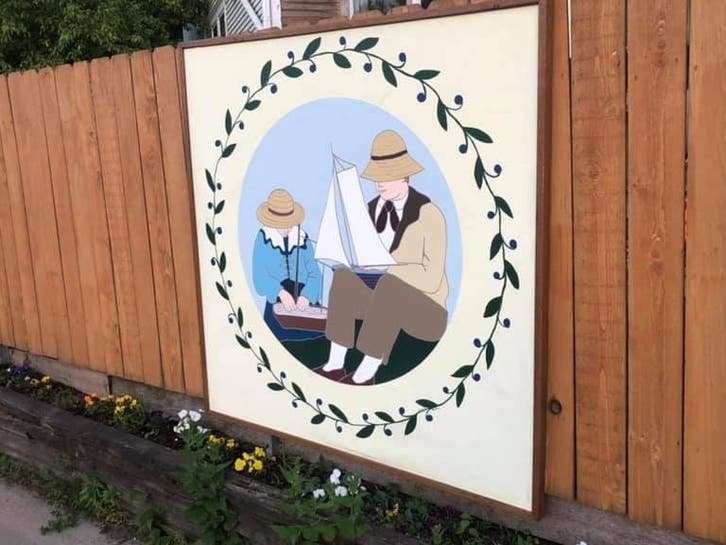
MADISON, WI— A year ago, Madison resident Morgan Robertson woke up to find a large painting of two old-fashioned figures fidgeting with toy sailboats — described by many as “mayonnaise” for its blandness — hanging from a stray nail on his fence.

In his initial amusement and confusion, Robertson posted about the scene in the Schenk-Atwood-Starkweather-Yahara or SASY Neighborhood Facebook group. Quickly stirring up speculation, the painting became the talk of the chat—enough so that Robertson decided to auction it off amongst the group members.

The auction raised about $800 for the Madison social justice organization Freedom Inc. which Robertson said was a way for the community to come together and do something positive during the COVID-19 pandemic and amid the backdrop of protests against police brutality.

“It was a nice moment in the middle of the pandemic, where we just got to laugh at something together,” Robertson said. “We can laugh at it, but can also do something good with it.”

And the impact lives on. The winning bidder, a local artist Wendi Kent, will receive the canvas in a few weeks to repurpose it and donate the profits from the new piece to a racial justice organization as well, Robertson explained.

The SASY Neighborhood is known for its quirkiness, affluence and active community—and this painting incident is one of the most SASY things to happen, Robertson said.

“We can all celebrate the quirkiness of a neighborhood that is affluent and not going through any of the major struggles that a lot of neighborhoods in Madison and up the road and down the road and other big cities are, so let’s also do something,” he said. “Why not?”

Beyond enthusiasm, of course, the neighborhood group also exploded with snarky comments and plenty of jokes at the expense of the painting—with comments like “is this new guerilla marketing for a Decemberist album?” or “this thing looks like it belongs on a Precious Moments plate,” Robertson joked.

The origins of the painting, which would later come to be informally named “White Nonsense,” mostly remain a mystery.

Based on one Facebook comment, Robertson said it is believed someone in the area bought it intending to paint over it, but eventually put it at the end of their driveway with the hopes someone would take it.

Still, no one has come forward admitting to hanging the painting on Robertson’s fence.

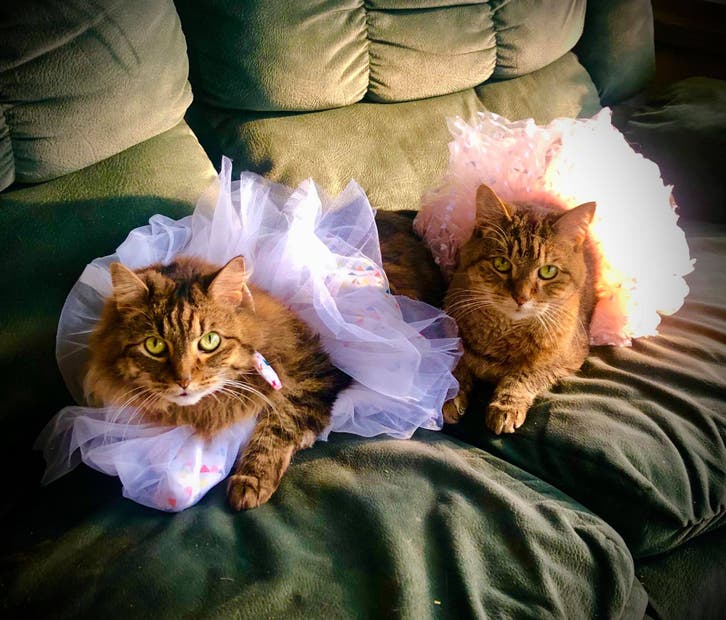
As if the situation could get any quirkier, Robertson explained, the painting is on a temporary loan to SASY resident, Caitlin Tefft to use as a backdrop for her two cats’ quinceañera photo shoot.

Tefft said she could get the cats to keep the quinceañera tutus on but having them sit still in front of the painting was a dealbreaker. As for the auction, Tefft said it was a great idea and something she wanted to participate in to raise some money during such an upsetting time in the world.

photo submitted

And, it encapsulated the spirit of the SASY Neighborhood.

“The SASY Facebook page is kind of notorious for being pretty ridiculous, and it can definitely get very obnoxious at times and highlight the worst of us, but sometimes it really hits the nail on the head of what is so delightful about our neighborhood—the humor, the generosity, and the kindness,” Tefft said.

Common Council Approves Police Monitor Description, CARES Manager

MADISON, WI—The Madison Common Council gave its final approval to the description of a new independent police monitor position after deliberations regarding the job description at a Tuesday meeting.

The independent monitor position will aim to provide oversight and accountability to the Madison Police Department. Responsibilities include working as a liaison between the community and addressing concerns of board members, various committees, and the mayor, as well as providing reports, reviewing the police chief and making recommendations to the department.

The position will report to the Police Civilian Oversight Board — a 13 person group created to hire and supervise the monitor. Additionally, the board works with the monitor and the community to make policing recommendations.

The board’s co-chair, Keetra Burnette, said that she hopes this position will take work “off of the shoulders of volunteers and onto the shoulders of paid staff.” The board facilitated over 20 meetings since Nov. 20 with the completion of the independent monitor position description taking top priority, Burnette said.

The Council adopted the board’s qualifications recommendations, which consider both education and experience. The monitor should have four years experience in a related position, understand the communities served, and in lieu of a postsecondary degree can have “an equivalent combination of education, training and experience shall also be considered,” according to the job description.

This was unanimously adopted by the council.

This came after a failed amendment to require, at minimum, a bachelor’s degree in a relevant field introduced by Sheri Carter, the Alder for District 14.

The position was initially created through recommendations from the city’s Madison Police Department Policy and Procedure Review Ad Hoc Committee and a consulting group called OIR. The Council first approved the idea of a monitor last September.

The annual salary will range from $103,636 to $139,909.

New CARES Position

The Council also voted unanimously to amend the Madison Fire and Public Health Madison and Dane County budgets to include a Public Health Specialist for the CARES program.

This position, Arvina Martin, the Alder for District 11, said, will help evaluate CARES, collect data, help grow the program and ensure it fits the needs of Madison. Martin, who has been spearheading the program along with others from organizations like Journey Mental Health Clinic, said it could be running by August.

The CARES program would also include social workers and community paramedics who would respond to mental health emergencies, alcohol or drug issues and wellness checks. Martin said this is a step in the right direction to make sure people get proper care and things are not escalated needlessly.

“This program has the potential to positively affect our most vulnerable neighbors, and get closer to finding successful and realistic solutions in both immediate situations, as well as long term ones,” Martin said in a blog post.

The city is moving forward with CARES by holding a public information session.

Every alder and Mayor Satya Rhodes-Conway sponsored the item.

Chapel Valley partners with pharmacy to help seniors get COVID-19 shots

file photo

Karen Woodson felt like she was “grasping at straws” while trying to get a hold of COVID-19 vaccines for her residents at the Fitchburg Chapel Valley Senior Apartments earlier this year.

Woodson, who oversees the building as Asset and Property Manager for Fleming Development, told the Star that getting her residents vaccinated, most of whom are over 65 years old, was possible because of Fitchburg Family Pharmacy.

Setting up a clinic in the building, Woodson said 20 residents received the Pfizer/BioNTech vaccine during a two-session clinic in early March.

She said in February, around 40 residents expressed interest in becoming inoculated, and signed up for the Chapel Valley clinic. But because of a vaccine shipment cancelation, the clinic was pushed back three weeks, leaving about 20 residents to get the vaccine through different avenue, like their healthcare provider, she said.

With the exception of that, Woodson said that the clinic ran smoothly. She said that was thanks to Fitchburg Family Pharmacy owner and pharmacist Thad Schumacher and a team of volunteers set up in the Chapel Valley community room.

She said that residents who could not attend the clinic were still taken care of.

“The great thing at the end is I had four people who weren’t able to get a vaccine during my clinic,” she said. “Thad got their information from me and he had them come the very next week over to his pharmacy, and the four of them got vaccinated right away.”

MPD warns Mifflin residents to follow county health guidelines or risk a citation

The Madison Police Department released a statement this past Monday warning Mifflin residents that they will be monitoring the anticipated Mifflin Street Block Party. They threatened to hand out citations for individuals caught violating county health orders and underage drinking. 

The annual block party, which is not sanctioned or permitted by the City of Madison, is expected to take place on Saturday, April 24. MPD issued a letter to Mifflin residents this week, outlining the precautions that possible attendees must follow per Public Health Madison and Dane County guidelines. 

Following Emergency Order 15, which went into effect on April 7, indoor gatherings where food or drinks are offered are limited to 150 people while outdoor gatherings no longer have a limit. However, during both indoor and outdoor gatherings, participants must maintain six feet of physical distancing. 

“Now is not the time to let our guard down,” PHMDC Communications Coordinator Morgan Finke said in an email to the Cardinal. “With more transmissible variants present in our community, we must continue to follow local guidelines; including wearing masks, washing hands and maintaining physical distancing.” 

Public Health violations can result in a minimum fine of $376, the letter states. 

Additionally, MPD said they will issue citations for alcohol and noise-related offenses. These include: 

  • Underage drinking – If you look under 21 and have alcohol, you will be asked to provide proof of age. (Mandatory Court and citation of $187 for first offense)
  • Procuring Alcohol – If you provide alcohol to someone who is not yet 21, you will be cited. This includes underage people who walk into your open home and help themselves to alcohol. You are responsible for controlling who comes into your home and any alcohol you have in your residence. ($376 per violation per roommate)
  • Dispensing Alcohol – You and your friends who are 21 or older can buy alcohol together and drink alcohol together, but you cannot resemble a bar. Any exchange of money for alcohol constitutes dispensing alcohol. ($681 per roommate)
  • Open Intoxicants on Public Street – The ‘Public Street’ extends from the sidewalk across the street to the opposite sidewalk. No open alcohol is allowed in this area. ($313) 
  • Unreasonable Noise – Unreasonable noise can include anything from a loud individual person to loud music coming from speakers or other devices. ($187 per roommate)

Last year, MPD implemented a harsher approach to enforce Gov. Evers’ Stay-At-Home Order, which asked Wisconsinites to avoid gatherings and stay in their place of residence as much as possible — only to leave for essential business and operations. 

UW-Madison plans to assist the city in enforcing public health measures, according to News and Media Relations correspondent Meredith McGlone.

“We support the City of Madison’s message to Mifflin Street residents and will assist them with holding students accountable through the Office of Student Conduct and Community Standards,” McGlone told the Cardinal in an email.

Mifflin Street resident and UW-Madison senior Holly Anderson said that last week police stopped by her house and neighboring Basset households, explaining that party-goers should social distance and wear masks out on the sidewalk. Police also stated that households who have too many people in their yards could face fines. 

“I’m really excited that Mifflin is a possibility this year, and I hope everyone is able to adhere to guidelines so we can all have the most fun possible,” Anderson said. 

Stoughton Village Theatre celebrates its centennial

photo submitted

Staci Heimsoth’s earliest memories of the Stoughton Village Players Theatre go back to 1975.

The Stoughton resident said she remembers many “snapshots” of her childhood in that theatre, which is celebrating its 100-year anniversary in 2021.

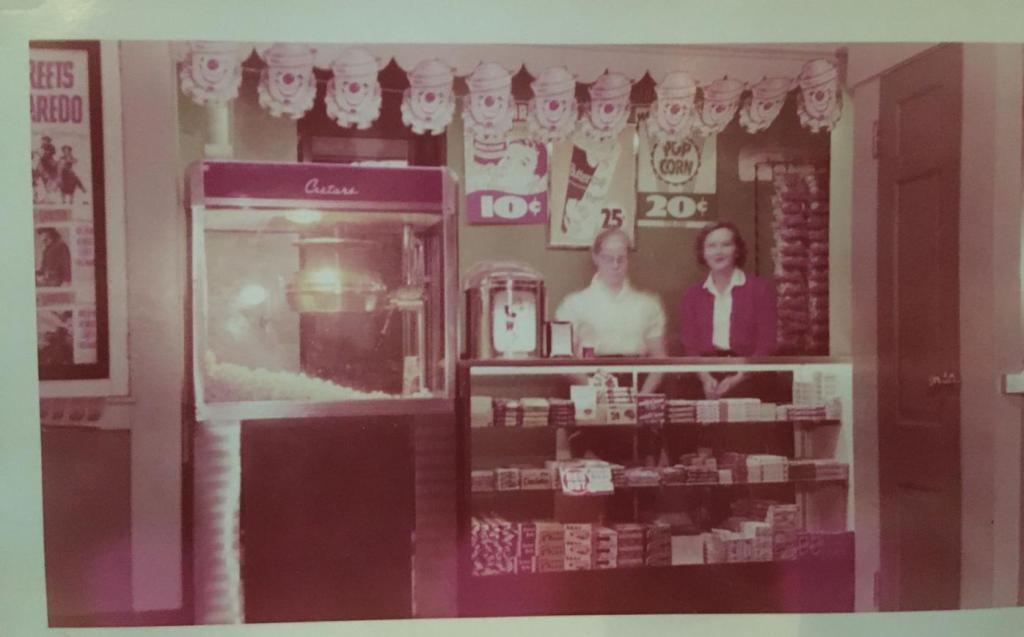
Back in the 1970s, it was called “Badger Theatre” and showed only movies. Decades later, there are still certain moments that stick out to her. Some include taking a field trip to see “The Sound of Music” with her Yahara Elementary class, as well as holding hands on her first date.

Village Players board member Dan Prueher told the Hub he’s been collecting historical research and personal accounts like Heimsoth’s, which the Players will feature in a video during Syttende Mai.

That video will showcase how the Players, celebrating their own 50th anniversary next year, got to inhabiting the theatre. It will also include some of the history behind when the building was regarded as the Badger Theatre, particularly its first silent film in 1921.

And while digging through old news clippings and articles, Prueher said it’s always been apparent how important the theatre is to Stoughton. For starters, geographically its Main Street location is in “the heart of downtown,” he said.

Beyond that, it is recognizable to multiple generations, he said. As decades passed and most businesses opened and then closed, Prueher said that the theatre has always been a constant.

And for a city like Stoughton, right outside of Madison, Prueher said that having that theatre was a source for local pride. As Madison movie theatres and chains multiplied through the 20th century, Stoughton residents could still see the latest features without having to even get in their cars.

But, Prueher said, its true connection to Stoughton lies in the personal accounts and clippings he’s been collecting.

One story Prueher heard was of a young couple looking to get married nearly 60 years ago. But being young and broke, the couple needed some extra money. So, they took to cleaning the theatre which involved an obscene amount of gum scraping thanks to the junior high kids.

It’s not just memories associated with the theatre, but those built into it. Prueher said that the bricks outside the theatre have served as a reminder for so many families about how important the theatre is to them.

Another story, describes how in March 1921, the Badger Theatre put on its first film, which was a silent movie titled, “Isobelle.”

Back then, a movie-goer would pay around five cents, choose among 700 seats (today there are 150) and enjoy a silent film accompanied by an in-house pipe organ. With no lobby and built on a sharp decline, it sounds like the original theatre would be unrecognizable.

But Prueher said that there are “hidden features” that reveal the building’s rich history. For example, “massively” thick indoor walls to protect from fire or lattice on the walls which cover up the organ’s pipes.

As entertainment and movie industry standards changed, so did the theatre. Eventually, there were “talkies,” blockbuster Disney films and serial cartoons which drew kids back to the theatre each week. In the late 1980s, the theatre was purchased by Dennis Lange, who gave it a new concept of a cinema cafe by installing a kitchen, tables and removing the angled floors.

Then in the mid-1990s, Tony Hill, an involved member of the Players, purchased the theatre, eventually passing it on and selling it to the group by the early 2000’s. The then Badger Theatre was vacant so the Players moved in, paid the bills and got to work.

It was not only to update the facilities, but to change it from a movie theatre to one suitable for the Player productions. This involved getting rid of the screens, building a stage, removing seats, knocking down concrete and hanging lights, he said.

With the help of subsequent fundraisers, the Players were able to officially buy the theatre in 2004. Being able to have a stable location but also own and have full control of the theatre isn’t common for small groups, Prueher said.

And about 15 years ago, Prueher said that the Players refurbished the theatre so it would have updated facilities and comfortable seats, yet pay homage to its former 1920s art deco style.

They made sure elements like the wall colors and marquee resembled original Badger Theatre designs — the one from Heimsoth’s memory.

“We needed to modernize the facilities, but we really wanted it to reflect the 100 year history,” Prueher said. “Everything we do is always with an eye towards history.“

Madison Natives Bring Uplifting Queer Stories Through Comics

MADISON, WI— When it comes to LGBTQIA+ characters, especially in historical fiction, longtime friends and Madison West High School alumni Zora Gilbert and Cat Parra were tired of seeing them live and die in tragedy.

Parra and Gilbert are the founders of a small press publisher, Margins Publishing, established in 2015, which serves as a platform for queer artists and allows the two comic-lovers to create stories they and other “queer nerds in their 20s” and teens need.

Over the past six years, dozens of queer artists and collaborators have worked and continue to work with Margins in a freelance type system, they described. Many of these collaborators are in the early stages of their careers and found Gilbert and Parra through accessible routes like social media.https://e8f6db4a823a87ae23f25e4ef0be8673.safeframe.googlesyndication.com/safeframe/1-0-38/html/container.html

Gilbert said that young LGBTQ+ artists and writers, especially people of color, can face institutional bias in the industry, which makes it difficult to get their foot in the door.

The publisher has created a community of networking queer artists. Not only that, but it has given new artists a platform and a helpful line to add to their resumes. Not to “toot our own horn,” Gilbert said, but they said it is a great opportunity for young artists to show they can work with editors and give them some confidence.

“We try really hard to make space for creators to tell their stories, and we also provide a structure,” Gilbert said. “We’re not mainstream publishing by any means but being able to point to an experience where they did work with a lot of collaborators, go through an editorial process, and at the end they had a piece printed in a book that you can hold—is a pretty big deal.”

Parra, a part-time artist based in Madison, and Gilbert, who works in production in New York, felt for a long time that media lacked rounded, queer characters who could lead happy and loved lives. Whenever a character was introduced in a show like “The Tudors,” Parra explained as an example, they would barely make it a full episode without catching some old-time disease.

So, Parra and Gilbert sat down to create some ground rules for the project which would come to be known as “Dates”—an anthology of the dynamic and joyful lives of fictional historical characters. This was their first project which Margins Publishing grew out of.

The three rules: the story must be set before 1965, it must center a queer character and no tragic endings allowed.

The timeline was quick between the initial idea in June 2015, searching for collaborators online, raising money on Kickstarter, and by February 2016, Parra and Gilbert were mailing out the physical books. “Dates” sold out in under a year, which Gilbert said is amazing for micropresses.

The anthology includes stories set in time periods like Napoleonic France or during the Joseon Dynasty in Korea with happy queer characters. Stories like these are what Gilbert described as “recasting expectations” of what people expect.

“We want people to have their grounding in history, of course, but we’re much more interested in creating uplifting reading experiences, rather than being like a historical document,” Gilbert said.

“Also, you can’t say that this didn’t happen,” Parra added.

Creating Margins to publish “Dates” under (and eventually “Dates 2” and “Dates 3”) wasn’t just a business move, but it was also a way to create a brand and put more similar content under it.

“This is all queer content, this is all focused around the sort of stuff that we’re interested in. It allows it to be connected to ‘Dates,’ but not part of ‘Dates’ and to be its own thing,” Parra said.

With new projects on the way, Parra and Gilbert are looking to branch out into new content but keep making uplifting, inclusive content.

“Queer people have been happy throughout history,” Gilbert said. “Queer euphoria has also been present throughout history–not just queer despair.”

The story of Thor and Olaf

Syttende Mai Viking cutouts are back to promote festival, Norwegian heritage

photo submitted

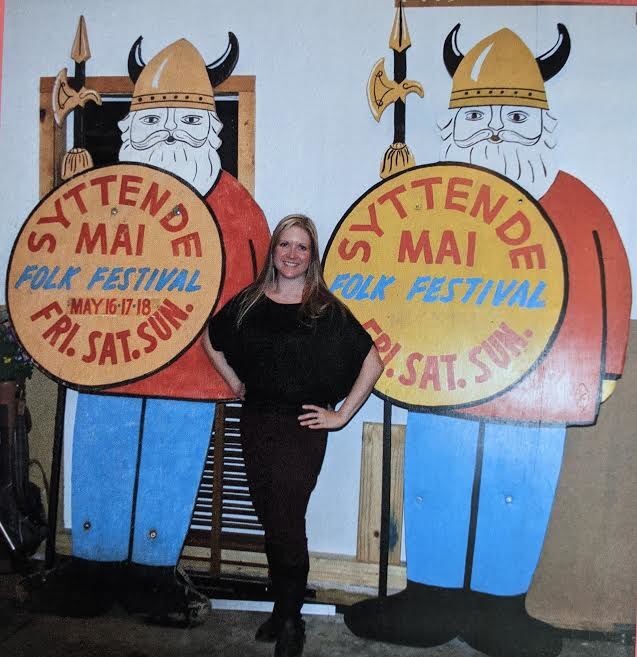
While both the age and origins of the Syttende Mai Viking cutouts that announce the return of the annual Syttende Mai festival remain a mystery to this day, their meaning to the Stoughton community is not.

Cheryl Schumacher, an artist who’s lived in Stoughton since 2007 and is now main caretaker to the Vikings, told the Hub that the two cutouts, Thor and Olaf, are a reminder of Stoughton’s strong Norwegian heritage and community traditions. Put out this year Monday, May 3, Thor stands on the corner of E. Main and County Hwy. 51-138, and Olaf stands at West Main and Gjertson streets.

The Vikings always hold wooden signs with the dates of the upcoming Syttende Mai festival, but this year, the cutouts also have face masks sewn with Norwegian patterns. Callie LaPoint, Events and Visitor Services Manager for the Stoughton Chamber of Commerce, said this was done to remind participants that Stoughton is a “conscientious community” and to take precautions during the festival, as the pandemic is still ongoing.

But the Viking cutouts do more than promote the festival to those driving into Stoughton, LaPoint said.

“The general welcoming nature is a sign that spring is here and that the festival is near,” LaPoint said in an email to the Hub. “Just a bit of nostalgia to those that grew up in the area and look for these Vikings each year.”

Neither LaPoint nor Schumacher – who has been searching for months – have ever been able to track down the exact age or origin of the Vikings. Schumacher said she remembers them greeting her at least 15 years ago when she and her husband Brett first moved to the city, and even though they are in great condition, they could be decades old.

Schumacher has created some of her own memories with the Vikings. Back in 2015, she was tasked to take the two cutouts home – away from their secret storage location – to give them each a fresh coat of paint.

Her children, who were ages three and five at the time, were big fans of “Frozen” and “The Avengers.” Hanging out with her in the garage while she worked, the Schumacher family nicknamed the cutouts Olaf and Thor – two “strong Norwegian” names featured in their favorite movies, she explained.

However, Schumacher said that sometimes people tend to refer to Olaf as Sven – another great Frozen-inspired name, she added.

And a hint, to tell them apart Thor has a bolt in both knees while Olaf has bolts in his lower leg.

From that point on, Schumacher has been the one keeping the Vikings looking fresh and updating their signs each year. But in 2020, she had to paint a different message: “Stay Safe, Stoughton. See you in 2021.”

“It was sad,” she said. “But then it was like well, it’s for you know, we have no choice and it was the right thing to do.”

And even though this year will look different than pre-pandemic festivals – there won’t be certain indoor events like the craft fair – Schumacher said she is looking forward to seeing the community come together in celebration again.

The Vikings are a friendly reminder that everyone who comes to Syttende Mai is Norwegian for a weekend, she said.

“I’m not Norwegian, yet anyone and everyone is welcome,” she said. “It’s such a fun festival, and I look forward to it every year.”

Stoughton native creates ‘Dream Crush’ game

Nick Prueher, designed a new take on retro sleepover games

photo submitted

Growing up in Stoughton, Nick Prueher never found the “boy” games he played at sleepovers to be a good way to get to know his friends.

Plus, they tended to include “ritual torture,” he said, laughing.

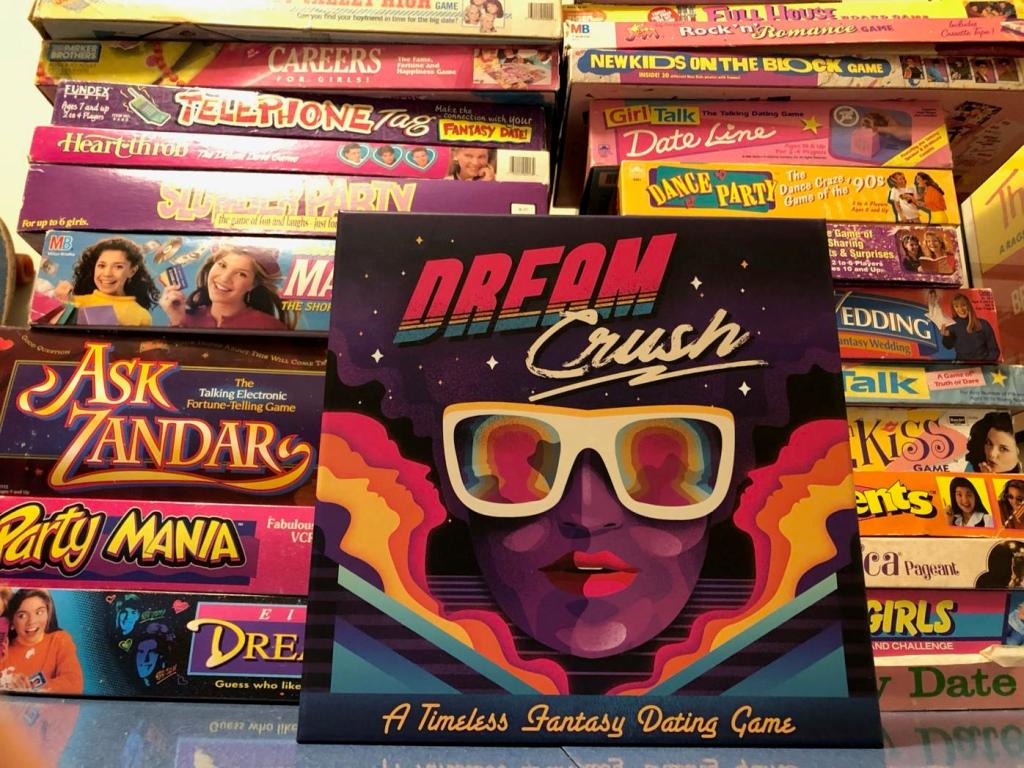
Wanting to create a modern, inclusive replacement to retro sleepover games, Prueher told the Hub he was inspired to create Dream Crush. The party game, which came out last month, is available at local stores.

Dream Crush, which is geared toward those 16 and up, is what Prueher describes as a fresh-take on beloved 1990s games, which can be a bit problematic, he said. He said he was careful to make his game LGBTQ community friendly and create diverse characters.

Essentially, players are trying to guess which character their friends are “crushing on.” For example, a character who “makes their own home-brew kombucha” and “is still going through a ska phase,” might be red flags for you but, unexpectedly, your friend’s type.

Prueher said it’s a good way to get to know your friends better, meet new people and spark some interesting stories.

“It really does work with all sorts of groups,” he said. “I thought initially it might just be something that this style of game was just fun for my group of friends and I as goofs–but I found that it was far more universal.”

Touring around with his friend and fellow Stoughton-native, Joe Pickett, with Found Footage Festival–a comedy show featuring old VHS footage, Prueher would occasionally break out his “homebrewed” game.

About 18 months ago, one of the participants was Tim League, CEO of Mondo Games. He was quite the fan, Prueher said, and it took off from there.

“So we started sort of honing it in and making play tests and refining it,” he said.

Prueher said he was able to have a very hands-on role in developing the game, but also work with some talented creators such as Chris Bilheimer. He designed the colorful “Dream Crush” box and is known for his work on 90s album covers like Neutral Milk Hotel’s “In the Aeroplane Over the Sea” and REM’s “Monster.”

Prueher, who has a background in comedy writing, said he stumbled into this bit unexpectedly, though games have always been a key part of family parties and high school hangouts. Settlers of Cataan and Risk were enjoyable, but Prueher said there was never much room for deep conversation with friends when focusing on military operations or farm management.

It was during these years that Prueher and Pickett, would wander through Stoughton and Madison thrift stores for old, comical VHS tapes to watch, memorize and act out in each other’s basements–and what would later turn into the Found Footage Festival.

And while digging around, Prueher said he uncovered lots of decade-old games aimed for girls at sleepovers. Games designed for girls to talk about things like boys, secrets and their feelings with each other.

Prueher said him and his friends were surprised at how fun these games were.

“Everybody came in with an open mind, and we actually had a ton of fun,” Prueher said. “It really led to some interesting discussions, you learn things about other people. The problem was that the games needed a series of updates, especially with today’s understanding of gender, diversity and things like that.”

Those old board games inspired Prueher to create a game on business cards, an early version of Dream Crush.

Prueher said the response from game-review websites and players has been great. He is planning a virtual event in April featuring himself and some surprise celebrity guests, and hopes to create extension packs, like Halloween or other seasonal versions.