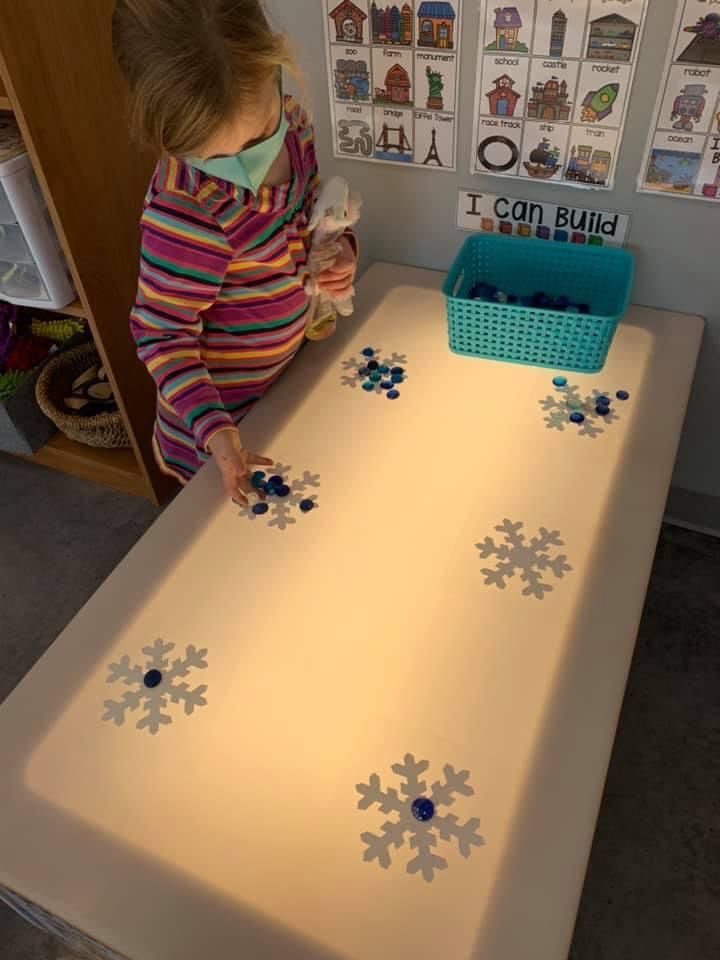
Teaching three and four year olds how to wear face masks is likely a new lesson in many preschool curriculums.
But at Pumpkin Patch preschool, 1940 Jackson St., teaching children ways to reduce the spread of COVID-19 sparked a new initiative called Healthy Start, fundraising chair Amanda Potratz told the Hub.
The project, which will run through the end of the 2021-22 school year, aims to equip kids with the skills to manage their health and wellness beyond preschool, Potratz said.
Beyond singing songs about handwashing and reading books about mask-wearing superheroes, as school director Natalie Richter described, the school wanted to show the children ways to manage their health during an unprecedented and unnerving health crisis.
The kids also garden to learn about nutrition, and practice yoga to maintain emotional balance, Potratz said.
As part of the initiative, the preschool additionally hopes to purchase new gym-equipment and make the playground wheelchair accessible, Potratz said. The initiative can also fund the purchase of cleaning supplies, personal protective equipment, an automated external defibrillator, as well as a snack fund with fruits and vegetables from a local farm.
Potratz described how, for Healthy Start, the school will partner with small local businesses for fundraising efforts, like having families sell coffee or chocolate. It is a way to simultaneously promote both Stoughton’s businesses and initiative.
“You know, bring some money back to the school to help build our community and try to think about fundraising in a holistic way,” Potratz said.
Like many businesses, Pumpkin Patch had a challenging financial year. Shortly after moving into a new building at the beginning of 2020, the uncertainty of schools coupled with costs of scarce cleaning supplies uprooted their excitement, Potratz said.
The early stages of Healthy Start were an effort to try to meet these costs, Potratz said. So far, donations from parents, as well as grants from organizations like the Department of Family and Children have helped the school afford supplies and pay staff, Richter said.
For the remainder of this school year Richter hopes to continue in-person learning, she said. So far, there has only been one case from a student, she said. But rather than just persevere through the year, she hopes Pumpkin Patch students will have positive takeaways to bring with them to elementary school and so on, she said.
“Hopefully, in the future, we can take some of our stuff we have learned with COVID and move forward and think positively,” Richter said.
The homeless are not invisible. Walk down State street or around Capitol Square any day or time. Look for carts of clothes and blankets chained up to bike racks. People are nestled into corners, asking for change or sitting in public places to warm up. Homelessness is part of Madison.
The cold is not uncommon in Madison, Wisconsin, where winter day dip below freezing. These months can be uncomfortable and unsafe for everyone, but the homeless are especially vulnerable to the elements. Madison’s homeless are reliant on nonprofits and faith-based organizations for temporary shelter and immediate resources to get through winter.
No one is surprised by the cold. Chris Archuleta, the outreach director of the student organization BundleUp, did not think anyone is surprised by the winters, but rather what level of preparedness to have.
“Homeless people may be assuming they can get into a certain place and then not have access to it. You know like if a shelter is passed capacity, so maybe shortcomings with respect to the execution of it,” Archuleta said.
Those experiencing homelessness, like Miguel Taylor, may not be too keen on going to the shelter, even knowing as the cold months approach.
“The shelters is not really a good place to be. Why? Because people steal from you, you have a curfew, and the bottom line is that I’m trying to make ends meet in the best possible way I know how,” Taylor said.
Taylor currently stays in a tent, pitched near John Nolan and takes it “one day at a time.”
When the temperature drops below 20 degrees, it is considered a “weather night” for temporary shelters. This means that the shelters expand their capacity because being unsheltered in extreme coldness could lead to hypothermia or death. No one can be left outside. Shelters like Porchlight and Salvation Army give clients a 90-night limit that resets every year. This means that a person cannot spend more than 90 nights in one of the shelters. Porchlight does not deny shelter to anyone on weather nights even if they have exceeded their limit, are drunk or have been previously suspended.
With policies such as this one and a general increase in need for resources, shelters and nonprofits are strained in the winter. Porchlight Director of Services, Kim Sutter, explained that the shelter may be serving around 40 to 60 people in the summer months, but for coldest days, that number can exceed 150. Porchlight operates three temporary overnight shelters that are housed in churches: Shelter One, Shelter Two and Shelter Three. Shelter One and Shelter Two are up and running the entire year, but Shelter Three is only available during the winter months due to increased demands. This expansion into a third shelter location is challenging because of a lack of funding that keeps staffing low. There may be just one staff member with 60 male clients at a shelter.
Freezing nights can lead to hypothermia or frostbite for anyone, but this risk is increased when alcohol is involved. According to poverty expert, Barbara Wolfe, alcohol can lead to irresponsible decisions, such as not taking the correct precautions to stay warm and safe. Shelters may be the safest choice for a homeless individual in regards to staying safe from the elements; however, that does not mean it is an ideal option. These shelters are usually in church basements with around 40 beds, open-air style.
“There aren’t very good ways for keeping people safe with the setup that we have because the setup is bad,” Sutter said. The open-air style lacks privacy, security and space, which can be especially challenging for people with mental health issues or behavioral issues who do are challenged by crowds.
It’s a Tuesday afternoon and the grounds of Mendota Elementary school are vacant. There are no students sitting for circle time. There are no teachers organizing crafts, games and lessons. Instead, students and teachers are at home learning virtually. Though it’s quiet now, in 24 hours there will be a pop-up pantry with dry goods, meats and produce; on the other side of the parking lot, there will be a public library book bus.
The staff and systems in place at Mendota Elementary have been supporting families in ways beyond education despite the physical barriers put in place by COVID-19.
Due to COVID, every school in MMSD began the school year in a fully virtual format. This means staff working with Mendota Elementary have physical limitations to their interactions and assistance with students and families. Though providing students with traditional services isn’t currently possible, families feel that the school is supporting their needs in these challenging times just as they had done before. Hailey Spring, a mother with two elementary-aged children, has had to take time off work to homeschool her children while taking online college courses.
“It’s been really hard because I don’t feel like I can go anywhere,” Spring said. She would rather her children be at home during coronavirus and believes the school has found ways to ensure student’s needs are being met and making the process as organized as possible. “They do so much at Mendota and even Madison School District are making sure that no matter what income the kids still get food boxes every week if they want to.”
Mendota, along with Leopold Elementary, transitioned to a community school in the 2016-2017 school year.
Madison Metropolitan School District defines a community school as a “place that builds on the assets of the community to help serve the identified needs of the students, families and community through well-integrated and coordinated, strategic partnerships.” Mendota is one of four community schools in the district—all of which are elementary level schools.
The school and community have a symbiotic relationship. The school has a resource coordinator who integrates services like vocational training, food pantries, health services and counseling between the school and community partnerships.
“The community school is a positive addition. There definitely was a need there,” Spring said.
The school builds bridges with school partners and community stakeholders to create opportunities for children and families—like accessing a school pharmacy, finding transportation to a job interview or leisurely activities such as a camping trip, according to PTO member and Mendota parent Beth Welch. These in-person social events and extracurricular opportunities were lost due to the pandemic.
“There were so many in-person community-building, relationship-building, and skill-building activities and opportunities and you can’t do that right now,” Welch said. “So that’s what has changed so it’s all transitioned to being virtual or drive-thru or offsite.”
The school play is one of those events which couldn’t be translated to a virtual platform. Mendota parent Shelly Patterson says her daughter was disappointed, and that the biggest struggle of virtual learning is the loss of social interaction through school and extracurricular activities.
Though things have changed, the school is still providing students with support and resources while following public health guidelines. The social and communal aspects of the school were stifled with the pandemic, but tangible needs such as backpacks full of supplies, technological help and equipment, and regular meal pickups have stayed consistent, according to parents. Additionally, the school is maintaining contact to check-in with families.
The school partners with the City of Madison and organizations to provide year-round free meals.
“I think they’re doing great. They have provided supplies for us. They are checking to see how we feel things are going, said Patterson. “They are really open to having interaction with the parent and trying to figure out what’s best for the kids.”
While some families have started learning pods, others are facing barriers like accessing stable internet access, finding childcare or just dealing with emotional stress. At Mendota Elementary nearly three-fourths of the student body is considered economically disadvantaged, according to the Wisconsin Department of Public Instruction School Report Card.
State Rep. Melissa Sargent, whose district covers much of Mendota’s neighborhoods, believes the pandemic is exasperating inequalities that already existed in our public school systems or childcare settings.
COVID is hitting communities facing social and economic inequities—often those from racial and ethnic minorities—the hardest, according to the CDC. Compared to other MMSD elementary schools, Mendota has the highest percentage of economically disadvantaged families.
The Madison Community School Framework was specifically designed around supporting low-income families, families of color, families who have a child with a disability and families who do not speak English. The connection and relationships between the school, families and community partners has the ability to increase equity and accessibility of opportunity, according to the framework.
“I would love to see the community school model welcomed and embraced, in particular in elementary schools,” said Rep. Sargent.
Many Mendota families were dealing with socio-economic challenges pre-COVID. These challenges will be amplified, but Mendota Elementary’s community model has created a supportive network to mitigate these effects and make sure families have somewhere to turn.
“I feel like if I really needed something I could call the school and if they could help provide it they would. I’ve actually always felt like that with Mendota,” said Patterson.
All nine community social justice organization recommendations for Police Civilian Oversight Board members have been announced ahead of this week’s Common Council session.
On Friday, Mayor Satya Rhodes-Conway and council leadership announced their recommendation for the final Police Civilian Oversight Board members based on a community group nomination.
“With these nominations, we get the Civilian Oversight Board off to a strong start,” said Council Vice President Syed Abbas. “Thank you to all the community groups who participated by nominating candidates and helped bring the Civilian Oversight Board to fruition.”
The board was established by a vote on Sept. 1 to ensure the Madison Police Department is held accountable by the community. The idea of an oversight board originally came as a recommendation from an Office of Research Integrity report in 2015, which was commissioned in response to the death of Tony Robinson, who was shot and killed by Madison police officer Matt Kenny.
The Mayor and Madison City Council leadership chose nine recommendations from 27 nominations made by local organizations. Additionally, Mayor Rhode-Conway nominated two members for the Board, Keetra Burnette and Keith Findley, and the Council will nominate two more this week for a total of 13 Board members
“There were over 75 applicants interested in serving on the Civilian Oversight Board, making our decisions very difficult,” Rhodes-Conway stated in a press release. “I am confident that both Ms. Burnette and Mr. Findley will bring experience, perspective and community connections that will help the Board succeed in its mission.”
Burnette is a senior director at United Way of Dane County and is a member of the Executive Team of the Black Leadership Council. Findley is a co-founder of the Wisconsin Innocence Project and was a co-chair on the MPD Policy and Procedure Review Ad Hoc Committee.
Another community group appointee, Isadore Knox Jr., was nominated by the NAACP. Knox is an active community member and retired public servant. He also served a term on the City Council for District 13 and worked in the Dane County Office of Equity and Inclusion.
Other appointees are Ananda Deacon, nominated by Freedom, Inc.; Joshua Hargrove, nominated by JustDane; Rachel Kincade, nominated by NAMI; Ankita Bharadwaj, nominated by OutReach LGBTQ+ Community Center, Yesenia Villalpando-Torres, nominated by UNIDOS Against Domestic Violence; Maia Pearson, nominated by Urban Triage; and Jacquelyn Hunt, nominated by YWCA.
Many of the appointees have strong ties to the Madison community through activism, public service and volunteer work. One of them is Shadayra Kilfoy-Flores, a longtime community advocate who spoke on policing-related issues at City Council Meetings.
Kilfoy-Flores was nominated by the Community Response Team — a Madison-based group of people who support community-based public safety alternatives.
The Police Civilian Oversight Board will later appoint an Independent Police Monitor and work with the community to review the Madison Police Department’s use of force, training, hiring, policy, community relations, etc and make recommendations. Additionally, the board will provide accountability over the implementation of the recommendations made by the 2019 MPD Ad Hoc Committee.
The Common Council will select the two final appointees this week to complete the 13-member board. All 13 appointments will be up for confirmation at the Common Council meeting on Oct. 6.
An amendment allocating $83,000 for a police body-worn camera pilot program was approved by the Madison Finance Committee on Tuesday and will advance to final deliberations for the 2021 Capital Improvement Plan.
The Finance Committee voted 4-2 to approve the body-worn camera pilot program, which would fund 48 body cameras for police officers. The City Council will decide in November whether or not to include it or not in the 2021 Capital Improvement Plan.
Ald. Barbara Harrington-McKinney brought the budget amendment forward. She felt that advancing with the pilot program was necessary to provide accountability and transparency to the community. Harrington-McKinney specifically referred to George Floyd, whose death was recorded on body cameras worn by the four officers involved.
“One of the things I want the committee to consider is the cost to the city if we do not have the cameras,” said Harrington-McKinney. “I want the committee to really consider how it is so important for us to have that vision. Is it a panacea, no it’s not, but it will have eyes. It will have verbiage and footage.”
The amendment received a majority vote, despite the City Council not yet receiving a conclusive report from the Body-Worn Feasibility Review Committee. The ad hoc committee was established in April at the recommendation of a previous committee created to study the Madison Police Department after the death of Tony Robinson in 2015.
“The reason is that I wanted to be proactive. I wanted the considerations that I am going to be moving forward to be part of the conversation,” said Harrington-McKinney.
While the amendment will go forward with possible approval for next year’s budget, the committee added language to make the program dependent on the final feasibility report regarding body camera use by MPD.
Objections came from Ald. Rebecca Kimble and Ald. Keith Furman. While they were not opposed to body cameras, both alders wanted the Council to wait for a recommendation from the Body-Worn Feasibility Review Committee.
“To me, this is flying in the face of a five-year-long process which is almost at the end,” said Kimble. “I feel we need to wait for that.”


 molly carmichael